
 Sight
 Food





Yabuli
About 2 hours from the city · about 2 h
One of China's largest ski areas, which hosted the skiing events at the 1996 Asian Winter Games. A good option for a winter day or overnight.
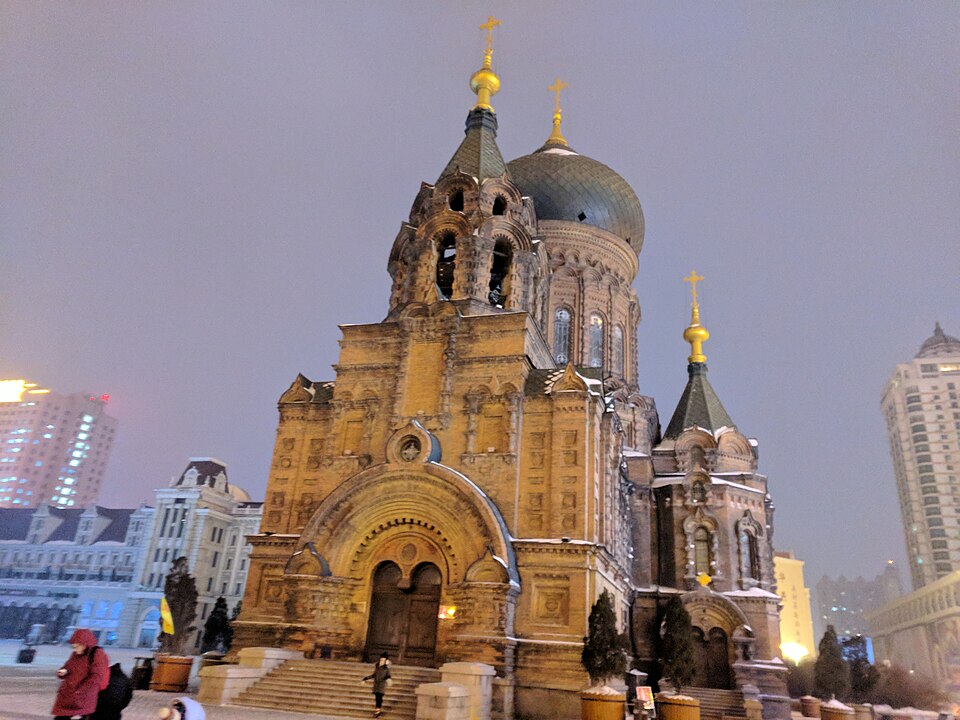
The story of the city
Harbin is China's northernmost big city, a Russian railway camp from 1897 that grew into a place of Russian building styles and ice buildings lit up after dark. Most of the Russians are long gone, but their architecture stayed. Come in January for the cold and the glowing ice, or in summer for late nights and beer on the street. It suits people who like walking old streets and eating loudly at big tables.
Yabuli ski area is within two hours of the city, so give it a day if you want to ski. The Unit 731 Museum is busy enough that you may struggle to see everything, so allow time.
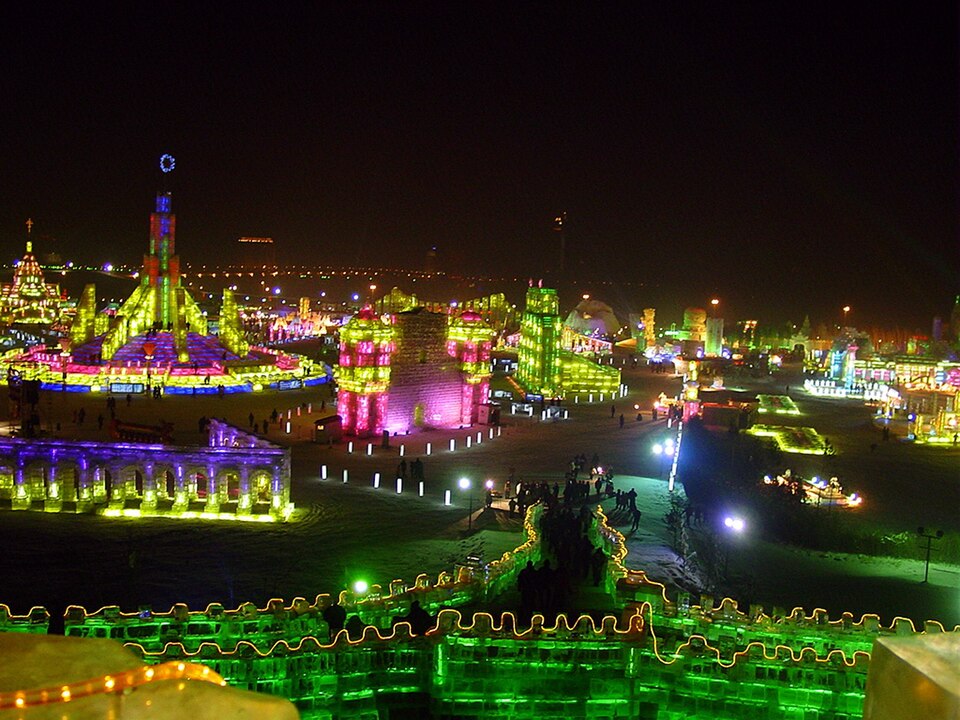 ExperienceIce and Snow WorldFull-size buildings and a 500 m slide made from blocks cut from the frozen Songhua River each December. The lights come on from late afternoon, so go at dusk and stay into the evening. Dress for minus 20 °C, or you will leave early.4.4(49.9K)
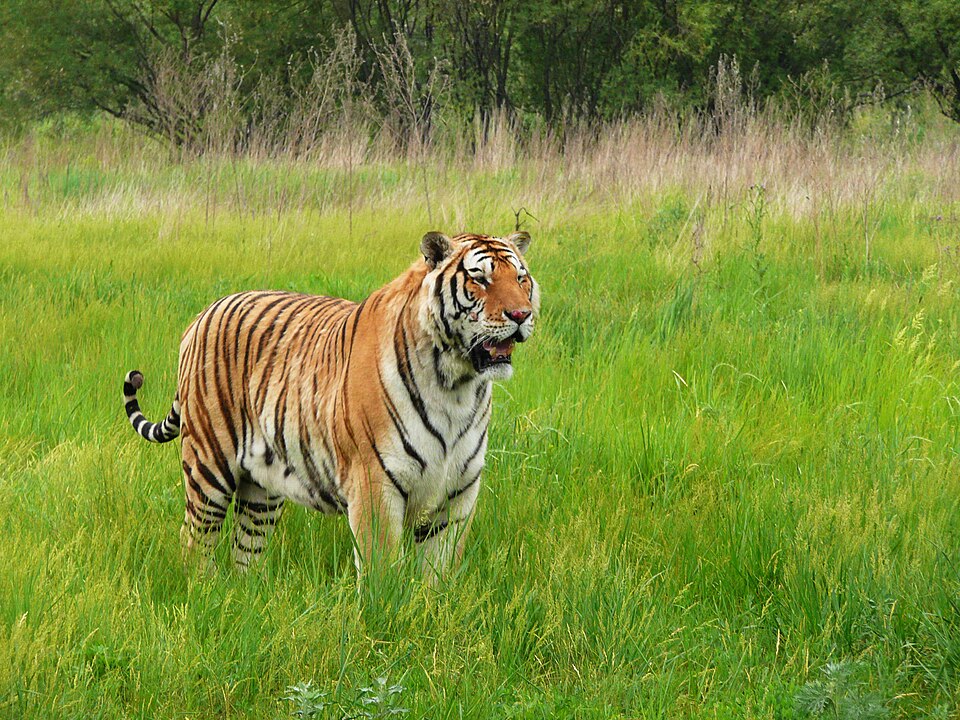 ExperienceSiberian Tiger ParkA park on the north bank with hundreds of tigers in large pens, which you view from a caged bus on a ride of about an hour. Visitors can buy meat and live animals to feed them. It is not for everyone, and it closes in the late afternoon.
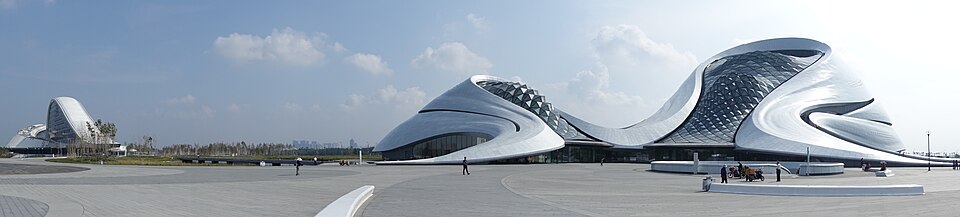 SightHarbin Grand TheatreA curved landmark building in Songbei, designed by Ma Yansong, with a 1,600-seat hall and a smaller 400-seat one. A sightseeing corridor and viewing platform look out over the wetland.4.7(77)
People have lived on this stretch of the Songhua River since the Neolithic, but for most of that time it was thinly settled. In 1115 the Jurchen leader Wanyan Aguda declared himself emperor and founded the Jin dynasty, and the Harbin area became part of the lands around its capital. Walls from one of its cities can still be seen a few kilometres south of Acheng. Under the Qing, Manchu and Han migrants moved in, and fishing villages gradually formed.
The modern city began with a treaty. In 1896 Russia pressed the Qing government for the right to build a railway across Manchuria, a shortcut that joined the Trans-Siberian line to the sea. Russia made Harbin its base for running the line, and a Polish engineer, Adam Szydłowski, drew the plans. The camp of 1897 was a boomtown within five years. The railway ran in full from 1903. A bridge finished across the Songhua in 1900 carried trains for more than a century and is now a footpath.
Then the city filled up with other people. After Russia lost its war with Japan in 1905, its hold loosened, and settlers from 33 countries moved in, with 16 consulates and hundreds of banks and firms. A railway census in 1913 counted 68,549 residents of 53 nationalities speaking 45 languages, and only 11.5 percent had been born in Harbin. Refugees from the revolution and civil war brought the Russian community to around 120,000 in the early 1920s, the largest outside the Soviet Union. They ran their own newspapers and two opera companies. More than 20,000 Jews also lived here, many around Zhongyang Dajie.
Fast growth had a price. Pneumonic plague reached Harbin along the railway from the border town of Manzhouli in late 1910 and killed 1,500 residents, about five percent of the city, most of them Chinese. Dr Wu Lien-teh, sent to investigate, won permission to cremate the dead, which turned the outbreak. He later founded Harbin Medical University, where his statues stand.
Japan invaded Manchuria in September 1931, and bombing forced the Chinese army out of Harbin within hours. Under the puppet state of Manchukuo the city became the base for Unit 731, whose main facility was built in 1935 at Pingfang, about 24 km south. Between 3,000 and 12,000 people died there in experiments, roughly 70 percent of them Chinese and 30 percent Russian. The site is now a museum. Most of the city's Jews left for Shanghai or Tianjin as the occupation tightened.
The Russian city ended in stages. The Soviet Union sold its share of the railway to Japan in 1935, and by the end of that decade about 30,000 Russians were left. The Soviet army entered on 20 August 1945, and in April 1946 the Communists set up a government here, making Harbin the first large city they ran. Most remaining Europeans were deported or emigrated, and by 1964 only 450 Russians were counted. Red Guards destroyed St Nicholas Cathedral in August 1966. Of more than 15 Orthodox churches that stood until 1949, about ten remain.
From the 1950s Harbin was an industrial city: thirteen of the 156 key projects of the First Five-Year Plan, built with Soviet aid, were here. That economy sagged in the 1990s, when mass layoffs at state factories left an ageing workforce and widespread unemployment. Winter became the next asset. The ice festival began in 1985, the city hosted the Asian Winter Games in 1996 and again in 2025, and in the 2023 to 2024 winter 87 million visitors came, mostly from elsewhere in China.
Eating in Harbin is a group activity. Northeasterners like to gather friends around one table and eat and drink the night away, so restaurants tend to be large, with round tables, and the volume can be extreme. Liveliness, known as renao, draws diners as much as the food does. Smaller, quieter places turn up mostly near universities and shopping areas. Harbin is also known across China for Russian food, though what you get is often adapted to local taste.
The long winter shapes the year. In summer, with the cold behind them, people crowd the streets late into the evening, eating kebabs and drinking Harbin beer. A night out often begins at a cheap barbecue or hot pot place, then moves on to a bar or a karaoke room, which seem to sit on almost every corner. If you don't drink, there is less to do after dark: bowling, pool or a tea house are the main alternatives.
Some habits catch the eye. Many residents wash at public bathhouses instead of at home, and these range from cheap to upscale. In warm months, and sometimes in winter, groups of older people dance yangge on the street in costume, with drums, and anyone is welcome to join. Foreign visitors, especially those with fair hair or a beard, should expect stares, photo requests and a few phones pointed their way.
Music is a real part of the city's identity. The Harbin Symphony Orchestra, founded in 1908, was the oldest in China, and Harbin No.1 Music School, opened in 1928, was the country's first music school. UNESCO named Harbin a City of Music in 2010. Local culture is Han at its base, combined with Manchu and Russian influences.
Religion here is a patchwork. Residents built the Buddhist Ji Le Temple in 1921 partly because they thought the Orthodox church had upset the local feng shui, and it is still active. Orthodox services now take place only at the Church of the Intercession. Daowai Mosque is the largest mosque in Heilongjiang. The Jewish heritage is told in the restored New Synagogue, which holds an exhibition on the community.
Winter sports are the local pride. Harbin hosted the Asian Winter Games in 1996 and 2025, and produced a string of Olympic medallists, among them short-track skater Wang Meng, a six-time medallist, and the pairs skaters Sui Wenjing and Han Cong, who won gold in 2022. The Heilongjiang Indoor Rink, opened in 1995, is the oldest of seven indoor speed skating arenas in China.
Winter is why most people come. In January the average high is minus 12 °C and the low minus 22 °C, and December and February are not much easier. The festival officially opens on 5 January, though ice and snow sculptures go up in December and last into March. Coal heating thickens the air in these months, so expect haze. Visitor numbers are large, with 87 million in the 2023 to 2024 winter, so plan ahead.
Summer is the other good season. July is the warmest month, with highs near 29 °C and lows near 20 °C, and August is only slightly cooler. That is mild for China, the streets are lined with trees and there is usually a breeze, so many people use Harbin as an escape from Beijing's heat. Evenings are long and lively.
Spring and autumn are cool. May reaches 21 °C by day but only about 10 °C at night, and September is similar. April and October are chilly, with daytime highs of 15 °C and 13 °C and nights near 2 °C. By November the day highs sit just below freezing.
Go in January or early February if you want the ice, and bring far more layers than seems sensible. Go in July or August if you would rather walk Zhongyang Dajie and Sun Island, which turns into a snow sculpture park in winter and is a pleasant stroll in warm months. If you can't choose, winter is the more distinctive trip.
Best months: May–Sep
This is the part of the old Daoli district that most visitors see first. The pedestrian street runs to the Songhua River, where a 22.5 m flood monument from 1958 marks its north end. From there you can walk east to the old railway bridge. Running off the street is Tongjiang Street, where the old synagogue is now a hostel and cafe. Come for the architecture and the ice lollies.
St Sophia stands at the corner of Zhaolin and Toulong streets. Nearby, the Heilongjiang Art Museum occupies a European-style building and holds Russian oil paintings and local woodblock prints. Zhaolin Park hosts ice lanterns in winter and is an ordinary pleasant stroll the rest of the year.
A century ago Daowai was the poorer side of the tracks, where local Chinese lived while rich foreigners lived in Daoli. Today it is a place to eat: small snack bars sell rib buns and halal dishes, and an old market near Shiliudao Street sells barbecued insects. Many snack bars are small with few tables and few menus are in English, so go to eat and not to sit comfortably.
Across the river lie the newer attractions. Sun Island is a park with a gondola back across the water, a place for wedding photos in warm months and a snow sculpture ground in winter. Ice and Snow World, the Grand Theatre and the Siberian Tiger Park are all in this district.
Harbin's street grid is turned about 45 degrees to follow the river, so Dazhi Street, the main road, runs diagonally and locals rarely give compass directions. Nangang has the Heilongjiang Provincial Museum, built in 1922, which recreates early 20th century street life. Around the Harbin Institute of Technology you find small bars and cafes.
Pingfang is a district about 24 km south of the old centre and the site of the Unit 731 Museum. The exhibitions describe the wartime experiments on over 10,000 civilians and prisoners and are well explained in Chinese and English. You can also walk through the original administration building and the burnt-out prison ruins. The museum is closed on Mondays and is crowded, so allow time.
About 2 hours from the city · about 2 h
One of China's largest ski areas, which hosted the skiing events at the 1996 Asian Winter Games. A good option for a winter day or overnight.
A few kilometres south of Acheng centre
The ruins of a 12th century Jin dynasty capital, with surviving city walls and a museum on the site. A good choice if you want the city's earliest history.
Train, about 2 hours · about 2 h
An oil city, home to China's largest oil fields. Worth it only if industry interests you.
Train, about 5 hours · about 5 h · worth a night
A large bird reserve near Qiqihar.
Train to Dedu, then a 2 hour bus · worth a night
A volcanic lake set among forests and small farming villages.
Overnight train to Hailar · worth a night
Some of the largest grasslands in the world in Inner Mongolia, best visited in summer.
Train south · worth a night
The most modern and cleanest city in the northeast, on the coast. A sea-air weekend if you are in Harbin for a while.
UK advice: No warnings
US advice: Level 2, exercise increased caution
Type A, C, I · 220 V
Bring an adapter unless your plugs are type A or C or I.
renminbi (CNY)€1 = 7.31 CNY · $1 = 6.67 CNY
Traffic drives on the right.
SIM and eSIM: China Mobile, China Unicom, China Telecom
Country calling code +86.
Spoken officially: Putonghua







