Do Try Visit
Chongqing
DoTryVisitKnow
Pick a city
Do Try Visit

The honest city guide. Ranked by the crowds who went, never by who paid.

Cities

  • Dubai
  • Istanbul
  • London
  • Paris
  • Bangkok
  • New York City
  • Singapore
  • Hong Kong
  • Rome
  • Barcelona
  • Tokyo
  • Kuala Lumpur

The fine print

  • How we rank
  • FAQ
  • Credits and sources
  • Community guidelines
  • Terms · Privacy

© Do Try Visit. Map data © OpenStreetMap contributors, tiles by OpenFreeMap. Photos from Wikimedia Commons, credited where shown. Facts from Wikidata, Wikivoyage, Wikipedia and official travel advice: see credits. 3D icons: Microsoft Fluent Emoji (MIT).

  • In this city

  • Cities

Chongqing/Know

The story of the city

Get to know Chongqing

Chongqing is a hill city where the Yangtze and the Jialing meet, and almost nothing in it is flat. Streets climb by stairs and escalators, a metro line runs through an apartment block, and dinner is a pot of chilli oil and numbing peppercorn. It is hot, hazy and a little rough, and people who like a city with grit and big night views tend to fall for it.

The old centre, the river at night and a few serious hot pot meals make a short stay. Add a day if you want the Dazu carvings, which are about three hours' drive west.

Language
Putonghua
Money
renminbi
Emergency
119 fire · 110 police · 120 ambulance

Contents

  1. Known for
  2. History2 min
  3. Culture and local life1 min
  4. When to go
  5. Areas
  6. Day trips
  7. Practical

Checked Nov 2026

  1. Known for
  2. History
  3. Culture and local life
  4. When to go
  5. Areas
  6. Day trips
  7. Practical

Known for

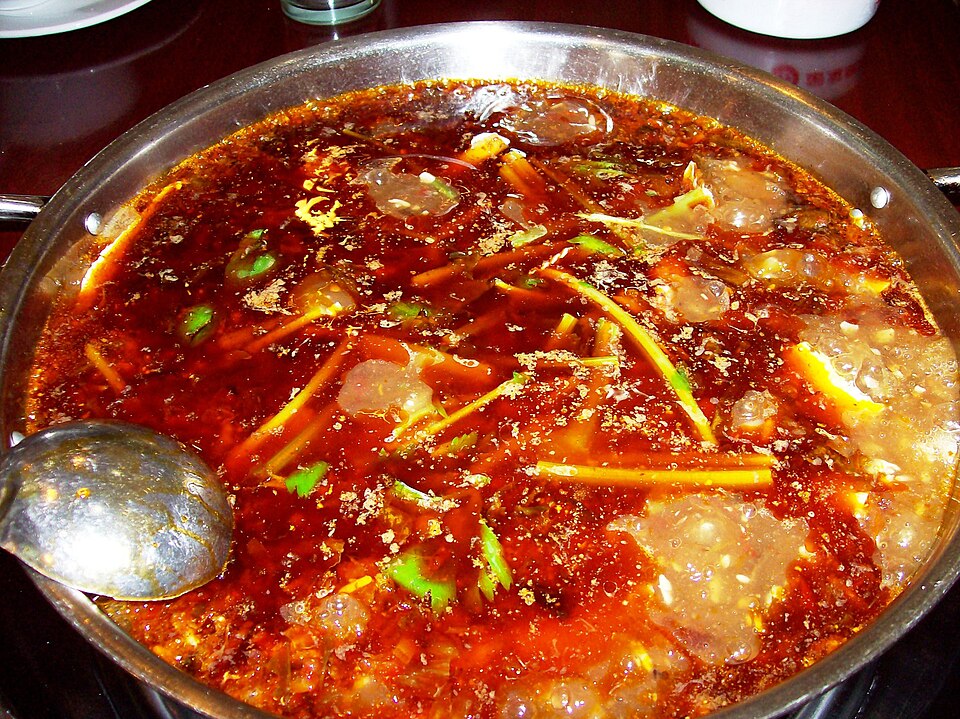
  • FoodChongqing hot potDock workers started it in the 1920s, boiling cheap beef tripe in a stove divided into sections. Today it is a red broth of chilli, Sichuan pepper and beef fat. If the heat worries you, ask for a pot split down the middle, and choose a reputable restaurant: in 2023 and 2025 some places were caught reusing old oil.
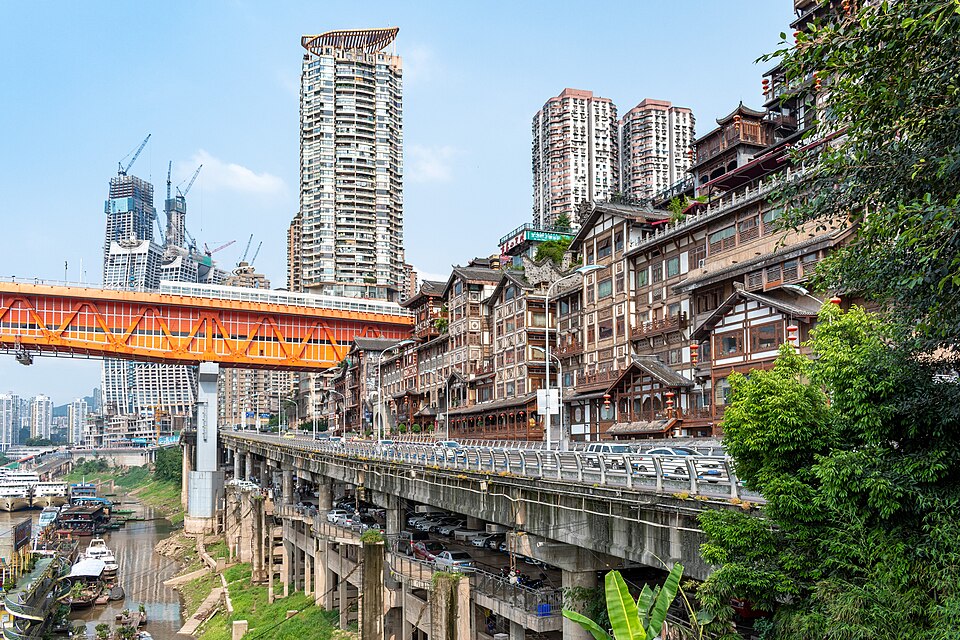
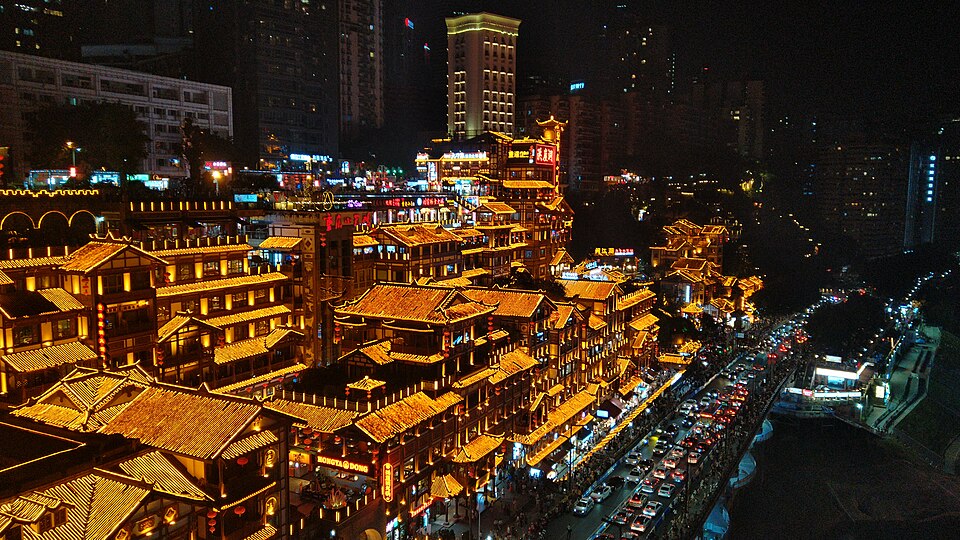
  • SightHongyadongAn eleven-storey stack of stilt-style buildings climbing the hillside above the Jialing, rebuilt from 2006 on the site of old riverside stilt houses. Its look has been compared to the bathhouse in the film Spirited Away. Go after dark, when the riverside is at its busiest.4.6(8.8K)
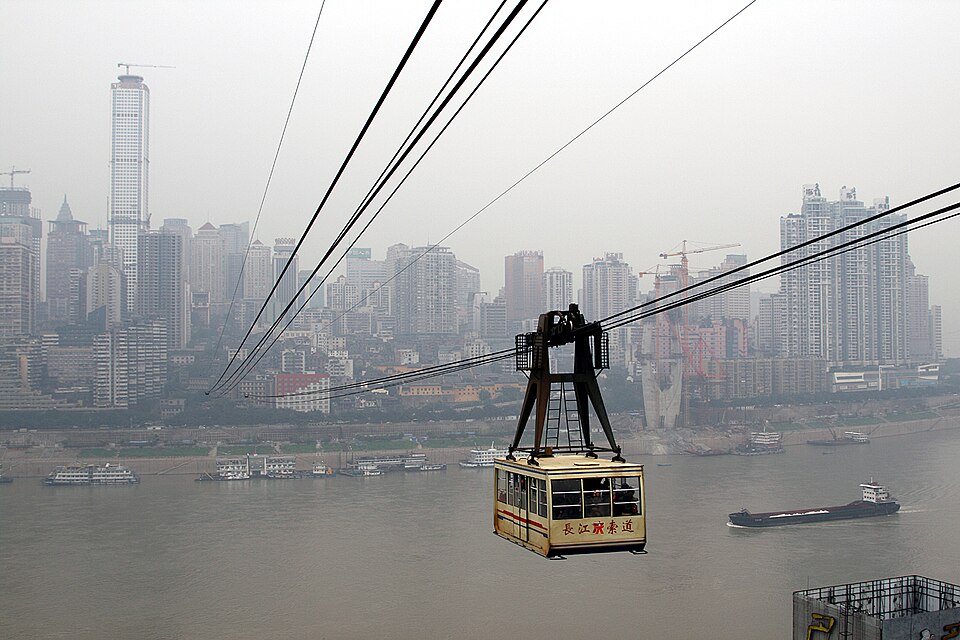
  • ExperienceYangtze River CablewayChongqing is the only Chinese city to have kept public aerial tramways, and this is the only one of its lines still running. It crosses the Yangtze for about 1.2 km in roughly five minutes. Take it for the view, not for speed.4.2(18.6K)
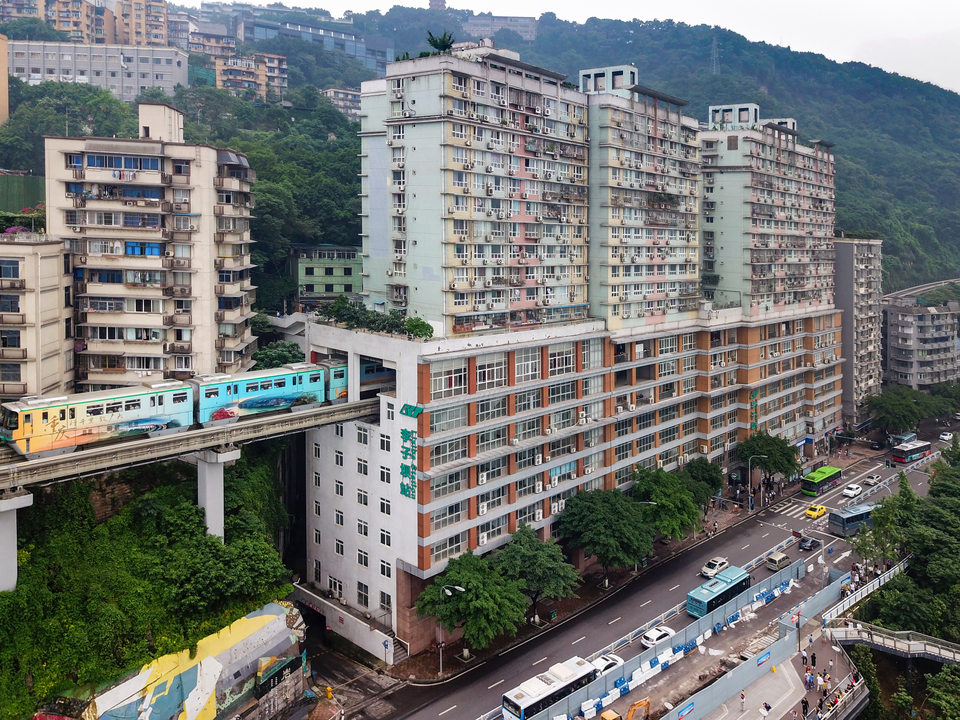
  • SightLiziba stationMetro Line 2 passes through the middle of a 19-storey residential block here. The viewing point is at the north end of Liziba Park, which also keeps wartime bank buildings and government offices.4.4(410)
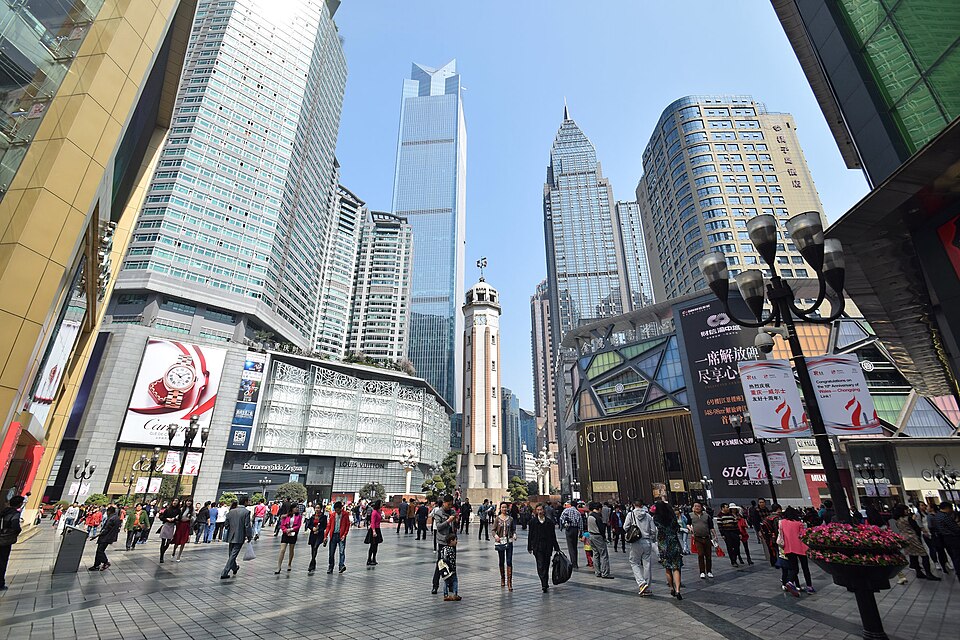
  • SightJiefangbeiThe downtown core is built around a 27.5 m monument that began as a memorial to victory in the war against Japan. More than 3,000 shops surround the square, which was finished in 1997, and it sits uphill from the Chaotianmen docks. It is commercial and crowded, and the food street Haochi Jie is not far away.4.7(5.6K)
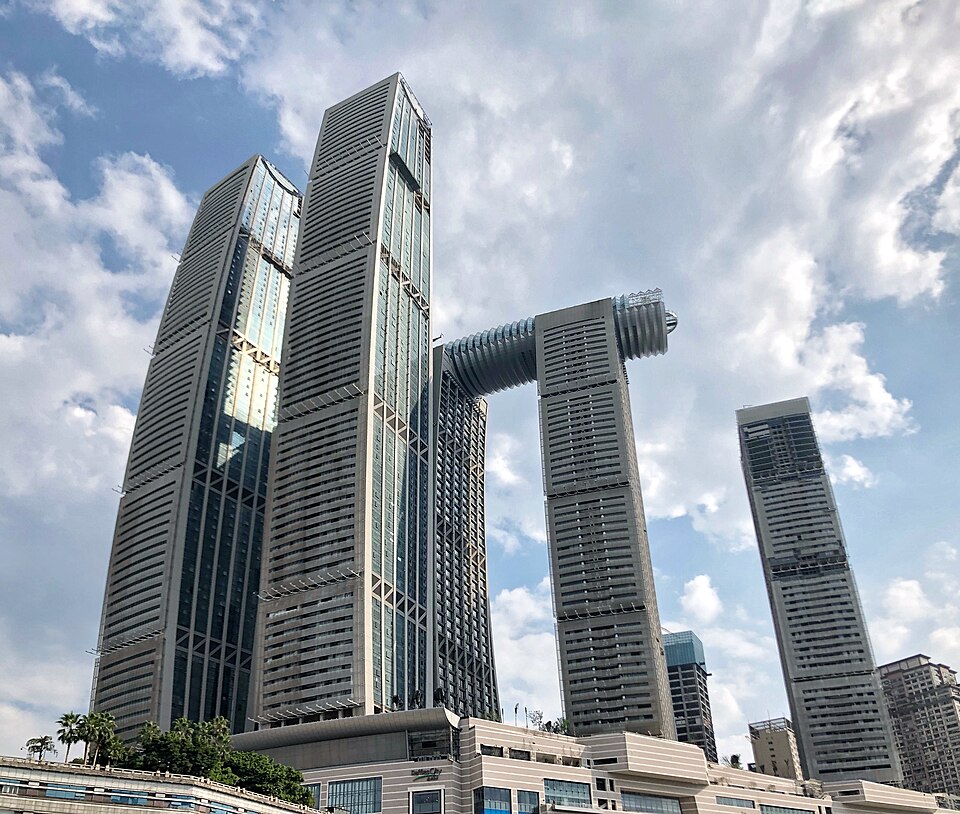
  • SightRaffles City and the CrystalEight buildings finished in 2019 where the two rivers join. A skybridge called the Crystal links four of them, 250 m up. The deck charges an entry fee; the free views from Chaotianmen Square are a fair substitute.4.6(511)
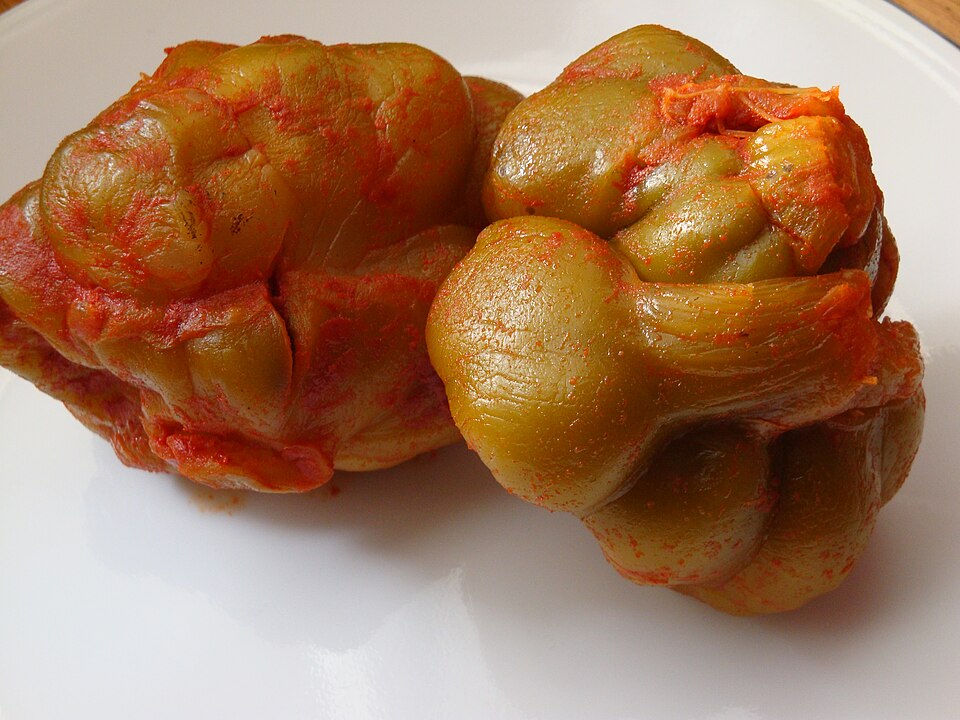
  • CraftLocal snacks to take homeThe local shopping list is edible: dried beef, Fuling pickle and mahua from Ciqikou. Spicy chicken from Fengdu and rice candy from Jiangjin are on it too.
  • SightCiqikouA river-port town that grew into a trading market under the Ming. Its steep, narrow lanes are packed with visitors, and the city's wartime years brought several well-known residents. Expect crowds.
  • ExperienceThe rivers at nightA one-hour evening cruise leaves from Chaotianmen and shows the skyline from the water. On Saturday nights a drone show fills the sky over the river junction, and in June 2025 it set a Guinness record with 11,787 drones.
  • FoodSmall noodlesChongqing xiaomian is the basic noodle bowl, served without toppings. Noodle shops will make any dish spicy or plain, so say which you want. Cold noodles are on the same menus, and dan dan noodles are the other local bowl.
  • ExperienceHot springsThe city counts dozens of hot springs, from big resorts to small neighbourhood pools. The three largest are in Beibei, Jiulongpo and Banan, and special tourist buses serve them.

History

2 min read

An early name for this spot is Jiangzhou, given by a Qin general, and the land is tied to the old state of Ba. Ba's best-remembered general, Ba Manzi, had promised the king of Chu three cities for military help. When the king came to collect, Ba Manzi refused to hand over the land and offered his own severed head. A museum in Yuzhong now stands around his tomb.

The name changed several times. In 581 it became Yu Prefecture, and Yu is still the city's one-character abbreviation and the root of Yuzhong, the old centre. The present name dates from 1189, when a Southern Song prince who had just become king, and then emperor, celebrated a double occasion. Chongqing means roughly that: a doubled celebration.

River trade made the city. After the Qing conquest, settlers moved in with imperial backing, and merchants from other provinces built guild halls; Huguang Guild Hall dates from 1759 and still stands. In 1891 Chongqing became the first inland port opened to foreigners, and the British had already set up a consulate in 1890. Steamships did not make the trip upriver without teams of human haulers until 1907.

From November 1937 to May 1946, Chongqing was the wartime seat of Chiang Kai-shek's government. Japanese bombers hit it from 1938 to 1943, and the hills helped: many people survived in shelters dug into the terrain. On 5 June 1941 hundreds, by some accounts thousands, died in a stampede inside one shelter tunnel, which is now a museum. Factories and universities moved here from the east, and the river port became an industrial city. The wartime embassies, residences and offices you can walk into in Yuzhong come from this period.

The Nationalists kept Chongqing as their capital until late November 1949. That same year a fire swept the waterfront and killed more than 3,000 people. Later, Beijing's Third Front campaign put heavy industrial investment into the city. Today it is third in China for building vehicles and first for motorcycles.

On 14 March 1997 Chongqing was split from Sichuan and made a municipality in its own right, absorbing three neighbouring prefectures. It was meant to lead development in the west and to resettle people from the Three Gorges Dam reservoir. Since then it has built bridges at speed: apart from the first two, from 1960 and 1977, every one of its Yangtze bridges dates from 1995 or later. Its downtown core is now a favourite of travel YouTubers.

  1. 581 · The area is renamed Yu Prefecture, the source of Chongqing's one-character abbreviation.
  2. 1189 · The city receives the name Chongqing.
  3. 1759 · Huguang Guild Hall is built for visiting merchants.
  4. 1891 · Chongqing opens as the first inland port accessible to foreigners.
  5. 1907 · A steamship reaches Chongqing without human haulers for the first time.
  6. 1937 · Chongqing becomes the provisional capital of Chiang Kai-shek's government.
  7. 1941 · A stampede in an air-raid tunnel on 5 June kills hundreds.
  8. 1949 · A waterfront fire kills more than 3,000 people, and the Nationalists leave in November.
  9. 1997 · Chongqing is separated from Sichuan and becomes a municipality.
  10. 2019 · Raffles City opens at the river junction.
  11. 2025 · Jiangbei and Yubei districts are merged into Liangjiang New Area.

Culture and local life

1 min read

Locals talk about matou wenhua, dockside culture. It is the habit of a harbour city, and people blame it for everything from heavy swearing to hot pot. The city has a lot of hot pot to blame: it counted 26,991 hot pot restaurants in 2019.

Hot pot is a meal for gathering families and friends, and hosts take it seriously. If a local friend takes you, expect them to keep your bowl full and to push drinks, and possibly cigarettes, across the table. Go with someone who can order if you do not read Chinese.

Chongqing was part of Sichuan until 1997 and is still considered Sichuanese in culture and language. Old customs survive in Ciqikou: temple fairs, dragon dances, dragon boat races, Sichuan opera and teahouse storytelling.

Folk religion, Taoism and Chinese Buddhism are the main traditions. Luohan Temple, a Buddhist temple from the Song dynasty, has rebuilt statues because the originals were destroyed in the Cultural Revolution.

The hills shape daily life. Streets and sights sit at different elevations, so people use stairs, escalators and bridges. The escalator beside Chongqing Railway Station is billed as the second longest single escalator in Asia, and it charges a small fare in both directions. In the evening, thousands of people dance in front of the Great Hall of the People.

When to go

Summer is the hard season. Highs reach 34 °C in July and August, and humidity stays above 75% in every month. In August 2022 the city hit 43.7 °C. Come in July if you like heat; otherwise, don't.

Winters are short and mild, and grey. The basin has little sun: 983 hours a year, fewer than much of northern Europe, and only 5% of possible sunshine in January against 43% in August. Fog covers the city for 68 days a year, and smog is worst from October to March.

Rain falls mostly from spring to early autumn, and late spring and early summer showers tend to arrive after dark. If you can choose, avoid the July and August heat and the October to March smog. That leaves spring, April and May, as the compromise: expect showers, not a furnace.

Festivals and events

  • Jan, FebSpring Festival at Baolun TempleCiqikou's Baolun Temple, built without a single nail, draws worshippers all year, most of all around the Spring Festival. The dates follow the lunar calendar.

Areas

Jiefangbei →

The commercial core of the Yuzhong peninsula, packed with malls, hotels and offices around a victory monument from the war. Hongyadong and the food street Haochi Jie are not far away. It suits first-timers who want everything within reach, and traffic is heavy in the evening.

Huaxinjie →

The west side of the peninsula, with the free Three Gorges Museum, Eling Park and the old banknote factory that became the TestBed 2 arts complex. The museum covers Ba culture and the Three Gorges, and the Qing, republican and wartime city. A short hike from TestBed 2 brings you to Eling Park, with views over both rivers.

Jiangbei →

The north bank, where Chongqing hot pot began in the 1920s. The Jiangbei and Yubei districts were scrapped in late 2025 and merged into Liangjiang New Area, so Jiangbei no longer has a district of its own.

Nanbin Road and Haitangxi →

Dining along Nanbin Road on the south bank comes with night views back across the Yangtze. Come in the evening.

Ciqikou →

An old port town in Shapingba. Besides the lanes there are courtyard houses: a compound built by a late Qing eunuch, and a collection of timber, stone and brick local dwellings. It suits people who like slow wandering and snacks.

  • Guanyinqiao 16
  • Nanping 9
  • Longmenhao 8
  • Longta 6
  • Yuzhonghuayuan 4
  • Longxi 4
  • Dashiba 3
  • Danzishi 3
  • Nanshan 3
  • Yuzhoulu 3
  • Tongjiaqiao 2
  • Yejincun 1
  • Lijia 1
  • Tanjiagang 1

Day trips

Dazu Rock Carvings

Bus from the Chen Jiaping long-distance bus station, about three hours. · about 3 h

A UNESCO World Heritage Site with 75 protected sites and some 50,000 statues, listed in 1999. The 500 m of carved figures mix Tantric Buddhist themes with scenes of everyday life.

Yangtze and the Three Gorges

Cruise from Chongqing, a multi-day trip. · worth a night

River cruises leave from Chongqing and pass the Qutang, Wuxia and Xiling gorges. Most end at Yichang in Hubei; a few go on to Shanghai.

Practical

Emergency

119Fire110Police120Ambulance

Safety

UK advice: No warnings

US advice: Level 2, exercise increased caution

  • UK, most of the EU, Australia, Japan, South Korea and more get 30 days visa-free to 31 Dec 2026; others need a visa first
  • 240-hour visa-free transit (57 nationalities, the US included) works via CKG with a booked ticket on to a third country
  • Always carry your passport: police spot-check ID, and trains, hotels and SIM cards all need it
  • Hotels register you with police at check-in; some small guesthouses can't take foreigners, so book one that does
  • Decline strangers' invitations to tea tastings, massages or bars; the venue then demands a huge fee
  • Take marked, metered taxis or DiDi; avoid unmarked cars and ask for a receipt

Power

Type A, C, I · 220 V

Bring an adapter unless your plugs are type A or C or I.

Money

renminbi (CNY)€1 = 7.31 CNY · $1 = 6.67 CNY

Tipping: Tipping isn't expected in China; rounding a taxi fare up to the next yuan is fine

  • Set up Alipay or WeChat Pay before you fly: verify with your passport and link a Visa or Mastercard
  • Phone payment is near-universal, from malls to market stalls; keep some cash as a backup
  • Since 1 Feb 2026, shops and public bodies must not refuse yuan cash, so cash still works as a backup
  • Foreign cards work at 3-star-plus hotels and top sights; elsewhere look for the card logo at the till
  • Get yuan from ATMs showing your card's network; check ¥100 notes, as fakes are common

Getting there

Chongqing Jiangbei International AirportCKG

  • MetroLine 10 from T3 or T2 via Chongqing North Station into the city, changing lines for Jiefangbei
  • MetroLine 3 monorail from T2 south to Lianglukou in Yuzhong, linking with Lines 1 and 2
  • BusAirport shuttle buses run from the terminals to Jiefangbei in the centre50 min · ¥20
  • TaxiMetered taxis from the terminal rank to the centre; avoid touts and insist on the meter40 min · about ¥80
  • ShuttleFree shuttle bus links T2 and T3 if your metro line or flight uses the other terminal

Getting around

  • Metro is the easiest way round this steep, river-split city; Lines 2 and 3 are monorails
  • Ride the metro by phone: Alipay's Transport section has e-transit cards for metro and buses
  • Hail taxis and cars with DiDi, which has an English version and also runs inside Alipay and WeChat
  • Use Amap (English edition: Amap Global) for maps and live transit; Google Maps is blocked
  • Book trains on Railway 12306 or Trip.com; you show your passport to buy the ticket and to board

Traffic drives on the right.

Staying connected

SIM and eSIM: China Mobile, China Unicom, China Telecom

  • Roaming on your home plan keeps Google, WhatsApp and Instagram working; a local SIM or hotel Wi-Fi won't
  • On a local SIM or hotel Wi-Fi, blocked services like Google, WhatsApp and Instagram won't load
  • Local prepaid SIMs need your passport; buy one at the airport or a carrier's city outlet
  • Free Wi-Fi is everywhere but often needs an SMS code, sometimes to a Chinese number
  • Alipay and WeChat sign up with a foreign phone number, so you don't need a local one to pay

Country calling code +86.

Language and manners

Spoken officially: Putonghua

  • Don't stand chopsticks upright in rice; it looks like funeral incense
  • Skip clocks, umbrellas and sets of four as gifts; they carry bad-luck meanings
  • Hotpot here is fierce: say 'wǒ bú yào là' (no spice) or order a split yuānyāng pot

Sources

Wikidata · Nov 2026UK Foreign, Commonwealth & Development Office · Aug 2026U.S. Department of State · Oct 2026European Central Bank reference rates · Nov 2026
Checked Nov 2026 against 14 sources, 5 official
  • Consulate-General of China in Adelaide
  • National Immigration Administration of China
  • People's Bank of China
  • State Council of China (gov.cn)
  • UK Foreign, Commonwealth & Development Office12
  • China Daily (China Bound)123
  • CQNEWS (Hualong)
  • iChongqing
  • Lonely Planet
  • Shanghai Municipal People's Government
  • The Cultural Atlas (Mosaica)
  • theculturalatlas.org
  • Wikipedia12345678910
  • Wikivoyage12345
7 photos from Wikimedia Commons
  • Chongqing hot pot: Hawyih, Public domain
  • Hongyadong: xiquinhosilva, CC BY 2.0
  • Yangtze River Cableway: 慕尼黑啤酒, CC BY 3.0
  • Liziba station: David290, CC BY-SA 4.0
  • Jiefangbei: Baycrest, CC BY-SA 2.5
  • Raffles City and the Crystal: Junyi Lou, CC BY-SA 4.0
  • Local snacks to take home: Sjschen, CC BY-SA 3.0
  • Chongqing
  • Do
  • Try
  • Visit
  • Know